Gantt Chart Maker Open App

Software launch Gantt chart template

A 16-week software launch plan: engineering hardening, beta, security and compliance, sales and support enablement, marketing, launch day, and 30-day post-launch monitoring.

Duration
16 weeks
Phases
6
Tasks
29
Format
.gantt
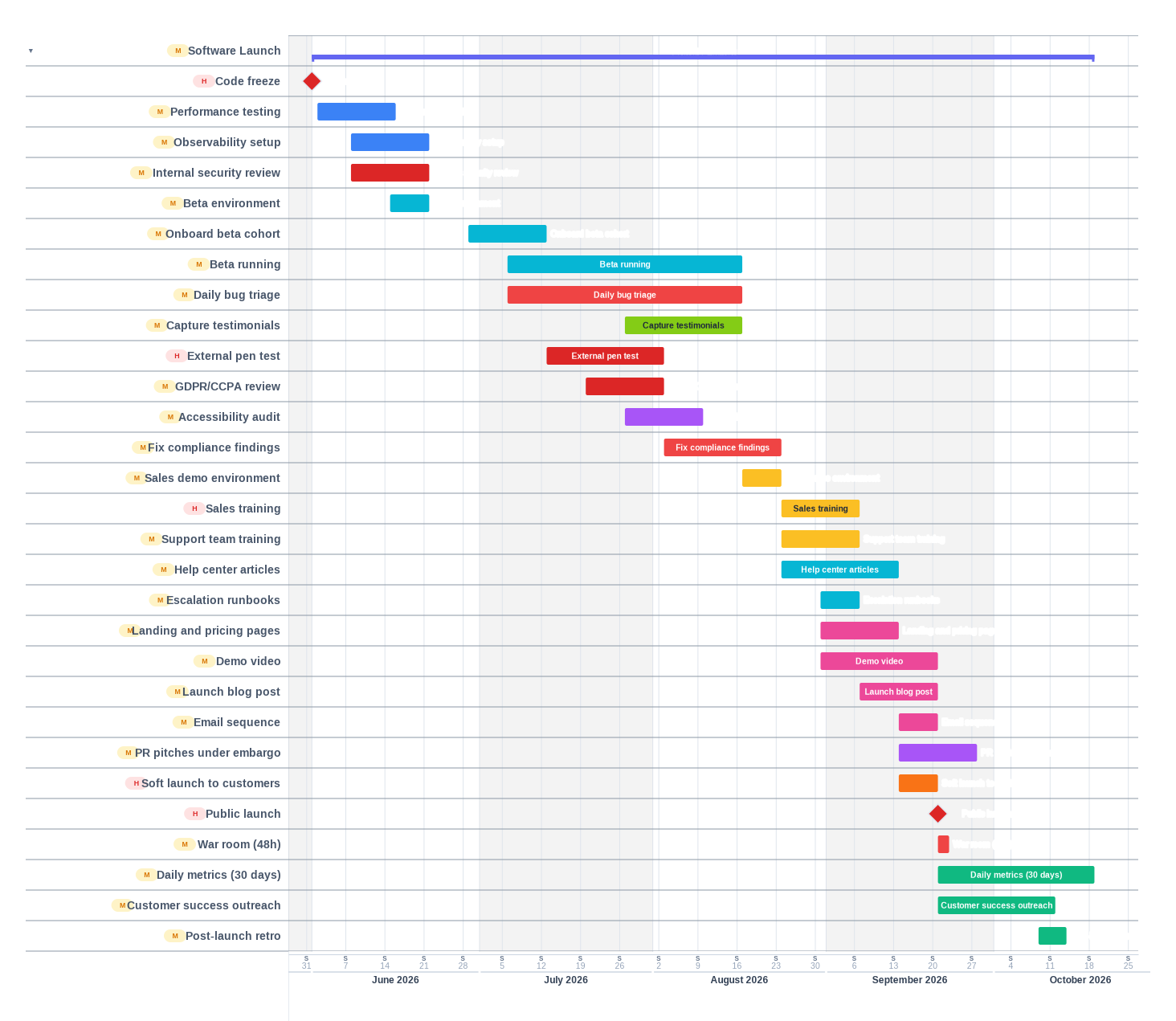
Software Launch29 tasks · 6 phases · 16 weeks
Software Launch Gantt chart: 29 tasks across 6 phases over 16 weeks
The template as it opens in the app. Its example dates start on 1 June 2026. Change them to fit your project.
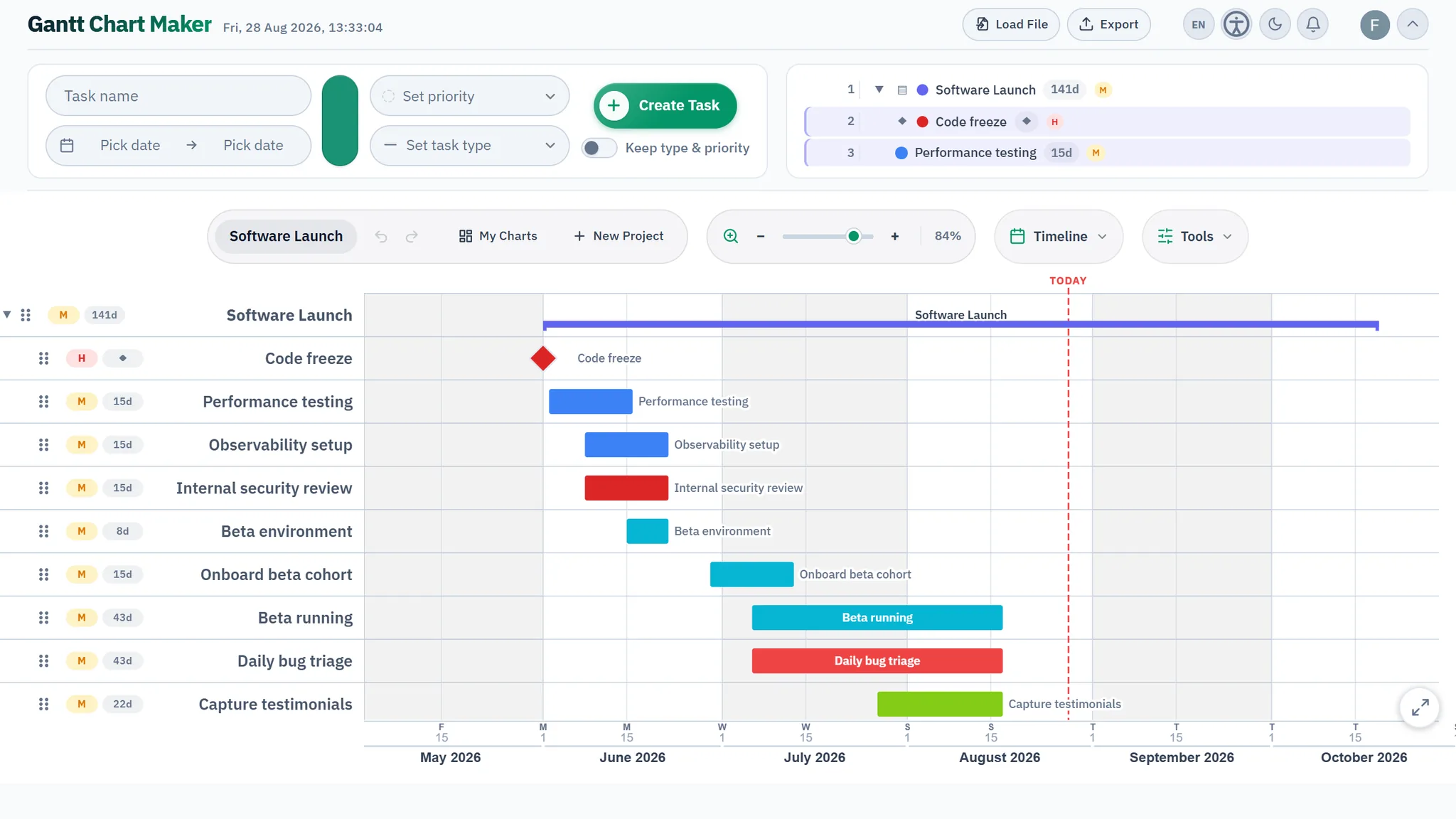
In the editorSoftware Launch
The Software Launch Gantt chart template open in the free Gantt Chart Maker editor, showing task bars, dependencies and the timeline

About this template

A software launch is two launches: the engineering launch (the system is ready, scalable, and observable) and the go-to-market launch (the world knows it exists and knows what to do with it). They have to land on the same day. This 16-week template plots both tracks in parallel: engineering hardening, security review, beta cohort, marketing buildup, and the post-launch monitoring window.

How a 16-week software launch breaks down

01

Hardening and beta prep

Weeks 1–4

Code freeze on new features. Performance testing under expected load + 2x. Observability: dashboards, alerts, error budgets. Security review of authentication, authorization, data handling. Set up the beta environment separate from production.

Steps in this phase
  • Code freeze on new features
  • Performance testing (2x expected load)
  • Observability: dashboards and alerts
  • Security review (authn, authz, data)
  • Beta environment setup
  • Beta documentation
02

Beta cohort

Weeks 5–10

Onboard 20–50 beta customers. Weekly check-ins. Track every reported bug. Triage daily. Fix the top 5 reported issues each week. The goal is not zero bugs. It is zero P0 bugs and a known list of P1s and P2s with workarounds. Capture testimonials for launch.

Steps in this phase
  • Onboard 20–50 beta users
  • Weekly check-ins
  • Daily bug triage
  • Fix top 5 issues/week
  • Capture testimonials
  • Update onboarding based on feedback
03

Compliance and audits

Weeks 6–12

External security audit (penetration test, SOC 2 if applicable). Data privacy review (GDPR, CCPA). Accessibility audit (WCAG 2.1 AA). Compliance findings get prioritized into the engineering plan. Most can be fixed in days, a few may need weeks.

Steps in this phase
  • External pen test
  • SOC 2 readiness (if applicable)
  • GDPR/CCPA review
  • Accessibility audit
  • Fix compliance findings
04

Sales and support enablement

Weeks 11–14

Build sales demo environment. Sales training on the new product, the new positioning, and the new pricing. Support team training. Build the support help center, FAQs, and escalation runbooks. Configure the in-app help and chatbot if applicable.

Steps in this phase
  • Sales demo environment
  • Sales training (positioning, pricing, demo)
  • Support team training
  • Help center articles
  • FAQ and escalation runbooks
  • In-app help configured
05

Marketing and launch buildup

Weeks 13–15

Landing page, pricing page, demo video, launch blog post, email sequence, PR pitches under embargo. Soft launch to existing customers 1 week before public launch to surface any final issues. The customer-first soft launch is the most-skipped step in software launches and reliably catches issues that the team missed.

Steps in this phase
  • Landing and pricing pages
  • Demo video
  • Launch blog post
  • Email sequence
  • PR pitches under embargo
  • Soft launch to customers (1 week early)
06

Launch and post-launch monitoring

Week 16

Public launch. Email blast, social, paid, PR embargo lifts. War room for first 48 hours. Daily metrics review for 30 days. Hot-fix any P0 issues immediately. Run the post-launch retrospective within 2 weeks of launch.

Steps in this phase
  • Public launch
  • War room (48 hours)
  • Daily metrics review (30 days)
  • Hot-fix P0 issues
  • Customer success outreach
  • Post-launch retrospective

Tips from software launches that landed

  1. 01

    Code freeze 4 weeks before launch. Late features cause late bugs.

  2. 02

    Run performance tests at 2x expected load. Real traffic comes in spikes; tests at 1x miss the second-day surge.

  3. 03

    Soft launch to existing customers 1 week before public launch. Catches issues the team missed.

  4. 04

    Build the war room and on-call schedule before launch day. Not after the first incident.

  5. 05

    Write the retrospective within 2 weeks. By week 4 half the team has moved on.

Questions

How long does a software launch usually take?

B2B SaaS: 12–20 weeks of focused launch work after the product is feature-complete. Mobile apps and developer tools often need additional time for app-store review or developer enablement.

What is the most-missed step?

Sales and support enablement. The team building the product knows it; the team selling and supporting it has to be trained.

When should I freeze new features?

4 weeks before launch for B2B SaaS, longer for high-availability systems. Every late feature is a late bug.

Start with this template

Open the software launch template, fit it to your launch date, and you have a working 16-week plan with engineering and GTM running in parallel.

Related templates

All 42 templates →