Gantt Chart Maker Open App

SEO campaign Gantt chart template

A 90-day SEO plan covering audit, keyword research, technical fixes, content production, backlinks and measurement, with the realistic ramp time SEO actually takes.

Duration
90 days
Phases
6
Tasks
24
Format
.gantt
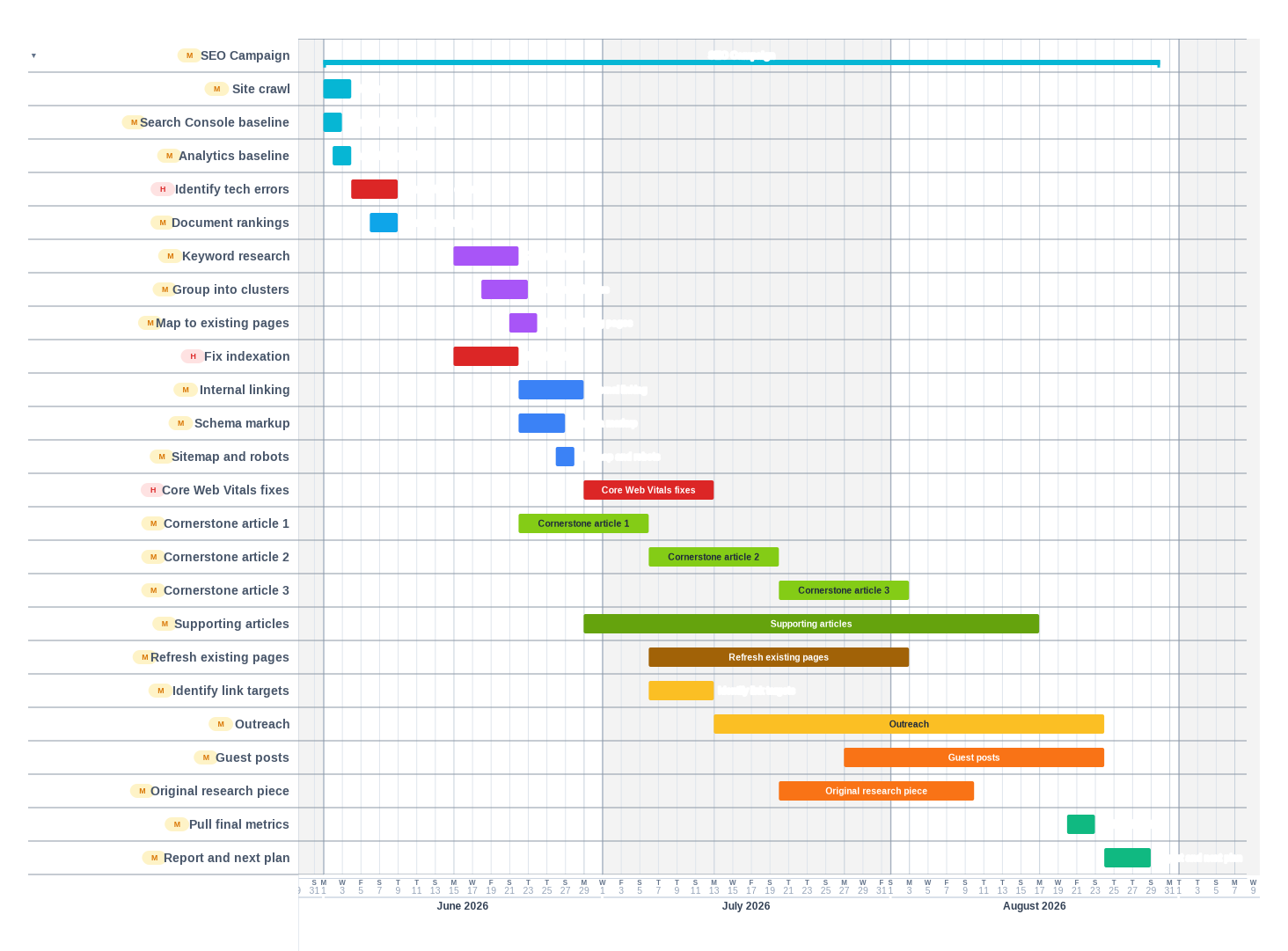
SEO Campaign24 tasks · 6 phases · 90 days
SEO Campaign Gantt chart: 24 tasks across 6 phases over 90 days
The template as it opens in the app. Its example dates start on 1 June 2026. Change them to fit your project.

About this template

SEO is a long game disguised as a marketing channel. A 90-day plan does not get you to page 1 for competitive terms; it gets you to a stable foundation, a working content engine, and the first wave of long-tail rankings. This template covers the work that actually compounds (technical fixes, topical clusters, and an early backlink push) paced to fit a single quarter.

How a 90-day SEO plan breaks down

01

Audit and baseline

Weeks 1–2

Crawl the site (Screaming Frog or similar). Pull Search Console and analytics baselines. Identify technical errors: 404s, redirect chains, indexation issues, Core Web Vitals failures. Document current rankings for target terms. The audit defines the rest of the plan.

Steps in this phase
  • Site crawl with Screaming Frog
  • Search Console baseline
  • Analytics baseline
  • Identify technical errors
  • Document current rankings
02

Keyword research and topical clusters

Weeks 3–4

Build the target keyword list: head terms, long-tail variations, question-based queries. Group into topical clusters (3–5 themes, each with 5–15 supporting articles). The topical cluster model outperforms scattered standalone posts.

Steps in this phase
  • Build target keyword list
  • Group into topical clusters
  • Map keywords to existing pages
  • Identify content gaps
  • Prioritize by intent + volume + difficulty
03

Technical fixes

Weeks 3–6

Fix indexation issues first (anything blocking Google from crawling). Then internal linking, schema markup, sitemap, robots.txt. Address Core Web Vitals. The LCP, INP, and CLS scores that affect ranking. Mobile usability fixes.

Steps in this phase
  • Fix indexation errors
  • Internal linking pass
  • Schema markup (Organization, Article, FAQ)
  • Update sitemap and robots.txt
  • Core Web Vitals fixes
  • Mobile usability fixes
04

Content production

Weeks 4–11

Produce one cornerstone article per topical cluster (2,500+ words, deeply researched). Then 4–8 supporting articles linking up to the cornerstone. Update underperforming existing pages: refresh is often higher ROI than new content.

Steps in this phase
  • Cornerstone article: cluster 1
  • Cornerstone article: cluster 2
  • Cornerstone article: cluster 3
  • Supporting articles (8–12 total)
  • Refresh underperforming existing pages
  • Internal link cornerstones to supports
05

Backlinks and outreach

Weeks 6–12

Identify 30–50 link targets: blogs, podcasts, journalists, partner sites. Personalized outreach (mass emails do not work). Guest posts where appropriate. Build digital PR moments: original research, surveys, or strong opinion pieces that earn natural links.

Steps in this phase
  • Identify link targets (30–50)
  • Personalized outreach
  • 2–3 guest post placements
  • Original research piece
  • Track new referring domains
06

Measurement and reporting

Weeks 11–13

Pull rankings, organic traffic, conversions, and backlink growth versus baseline. Identify the keywords moving from page 3 to page 2 (next quarter's wins). Write the post-campaign report with the next 90-day plan baked in.

Steps in this phase
  • Rankings vs. baseline
  • Organic traffic and conversions
  • Backlink growth
  • Identify page-3-to-2 movers
  • Next 90-day plan

Tips from SEO programs that worked

  1. 01

    Fix technical issues first. Content on a broken site does not compound; content on a fixed site does.

  2. 02

    Use topical clusters, not scattered posts. One cornerstone with 8 supporting articles outperforms 9 random posts.

  3. 03

    Refresh existing top-performing pages quarterly. Refresh ROI usually beats new content.

  4. 04

    Personalized outreach beats templated outreach 10:1. Spend the extra 5 minutes per pitch.

  5. 05

    Most SEO results show at month 4–6, not month 3. Plan for the long game; report on leading indicators.

Questions

How fast does SEO show results?

Long-tail rankings start moving in 8–12 weeks. Competitive head terms take 6–12 months.

How much content per month?

2–4 high-quality articles per month outperform 10–15 thin ones. Quality beats volume at every measurement.

Do I need backlinks?

For competitive terms, yes. For long-tail and niche queries, on-page SEO plus topical authority is often enough.

Start with this template

Open the SEO template, fit it to your quarter, and you have a working 90-day plan from audit to measurable rankings.

Related templates

All 42 templates →