Gantt Chart Maker Open App

Marathon training Gantt chart template

A 16-week marathon training plan covering base building, long runs, speed work, taper and race day, with the weekly mileage progression that prevents the injuries that derail most first marathons.

Duration
16 weeks
Phases
5
Tasks
24
Format
.gantt
Marathon Training24 tasks · 5 phases · 16 weeks
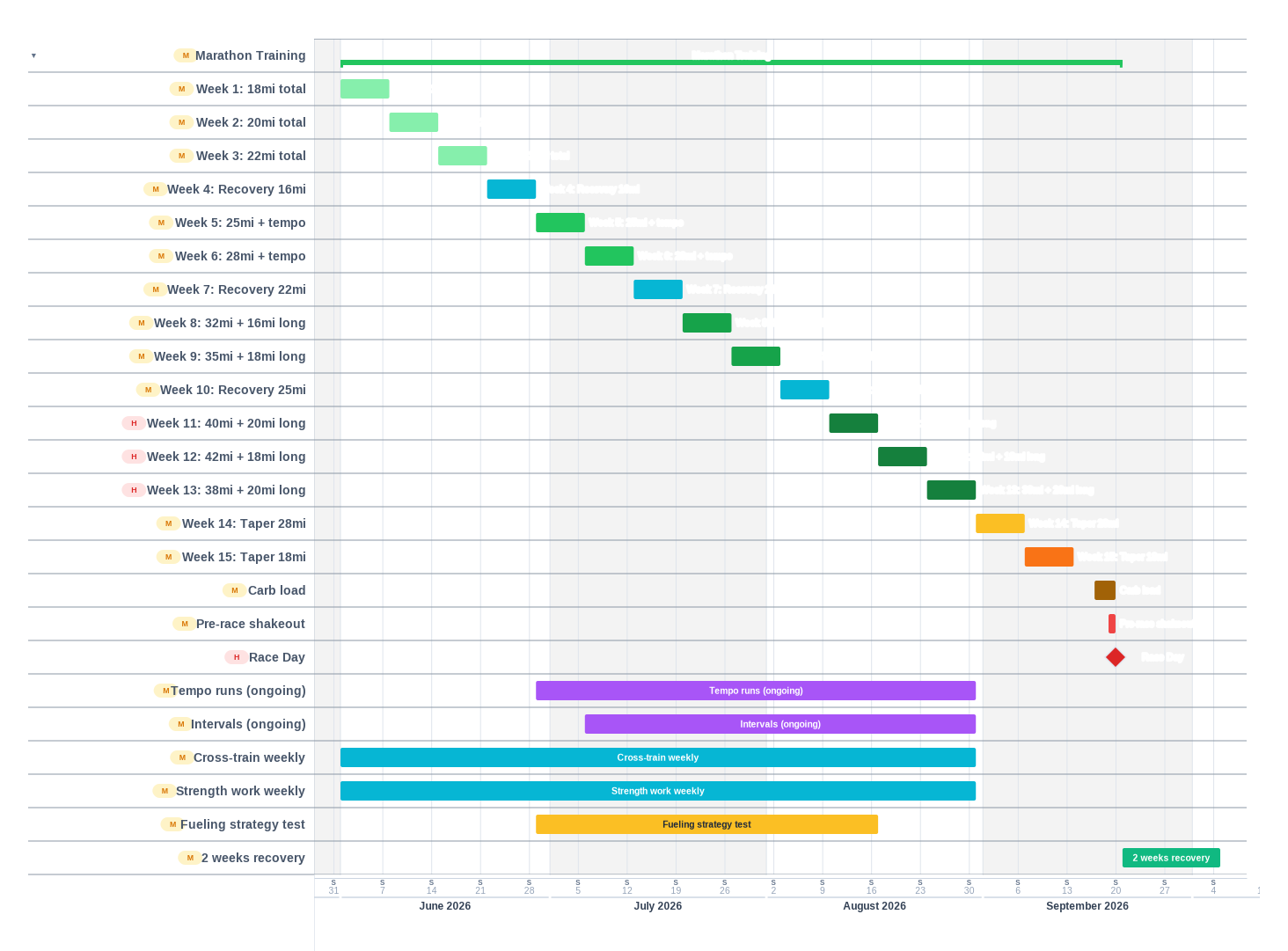
Marathon Training Gantt chart: 24 tasks across 5 phases over 16 weeks
The template as it opens in the app. Its example dates start on 1 June 2026. Change them to fit your project.

About this template

First marathons fail in week 10 from injury, not race day from underfitness. Mileage progression is the safety mechanism: increase weekly mileage by no more than 10% week over week, with a recovery week every 4 weeks. This 16-week template builds from a base of 15–20 miles per week to a peak of 35–45 miles per week, then tapers for the final 2 weeks. Adjust mileage to your starting fitness, and pace yourself off the long run rather than the speed sessions.

How a 16-week marathon plan breaks down

01

Base building

Weeks 1–4

Build the aerobic base. 4 runs per week at easy conversational pace. Long run grows from 8 miles to 12 miles. Total weekly mileage from 18 to 25 miles. Cross-train (cycling, swimming, yoga) 1–2 times per week. The goal of these 4 weeks is uninjured progression, not speed.

Steps in this phase
  • Easy runs (4 per week)
  • Long run grows 8mi → 12mi
  • Cross-train 1–2x/week
  • Strength work 1x/week
  • Recovery week 4
02

Build to peak

Weeks 5–10

Introduce speed work: one tempo run and one interval session per week. Long run continues growing, peaking at 20 miles in week 10. Pay attention to nagging pains; minor injuries in this phase become major ones in week 14. Hydration and fueling strategies tested during long runs.

Steps in this phase
  • Tempo run 1x/week
  • Intervals 1x/week
  • Long run grows to 20mi
  • Fueling strategy on long runs
  • Recovery weeks 7 and 10
03

Peak weeks

Weeks 11–13

Highest mileage of the plan. Long run stays at 18–20 miles. One quality speed session per week. This is where the body is being asked the most: sleep, nutrition, recovery matter more than ever. Race-pace miles in some sessions to dial in goal pace.

Steps in this phase
  • Highest weekly mileage
  • Long run 18–20mi
  • Race-pace miles
  • Sleep and recovery priority
04

Taper

Weeks 14–15

Reduce mileage by 25% in week 14, another 35% in week 15. Speed work stays in to keep legs sharp, just shorter. Avoid new shoes, new fuel, or new stretches. Trust the work; the fitness is already built.

Steps in this phase
  • Reduce mileage 25% week 14
  • Reduce mileage 35% week 15
  • Short speed sessions
  • Race-day logistics planned
  • Carb load (3 days out)
05

Race week and recovery

Week 16

Easy runs early in the week, last run 2 days before race. Carb load starting 3 days out. Lay out kit the night before. Race day. Pace conservatively the first half, push the second half if legs feel good. Recovery: 2 weeks easy or off, then resume training if continuing to race.

Steps in this phase
  • Easy runs week of
  • Last run 2 days out
  • Carb load (3 days out)
  • Pre-race shakeout
  • Race day
  • 2 weeks recovery

Tips from finished marathons

  1. 01

    Increase weekly mileage by no more than 10% week-over-week. The 10% rule is the single biggest injury prevention tool.

  2. 02

    Take a recovery week every 4 weeks. The plan must include reduction; otherwise the body never adapts.

  3. 03

    Test fueling on long runs. Race day is not the day to find out an energy gel does not agree with you.

  4. 04

    Trust the taper. Tapering feels wrong but the fitness is already built.

  5. 05

    Pace conservatively the first 13 miles. Going out too fast is the #1 cause of bad marathon finishes.

Questions

How long should I train for a first marathon?

16–20 weeks is the recommended range for first-time marathoners with a running base. Less than 14 weeks risks injury; more than 24 risks burnout.

What is the most common injury?

IT band syndrome, plantar fasciitis, and runner's knee. Most are overuse injuries from increasing mileage too fast.

Should I run all four runs at the same pace?

No. Easy runs should be conversational pace; tempo runs should be comfortably hard; intervals are hard. Mixing intensity is what builds different physiological systems.

Start with this template

Open the marathon template, set race day, and you have a working 16-week plan with the progressive mileage that builds fitness without injury.

Related templates

All 42 templates →