Gantt Chart Maker Open App

Job search campaign Gantt chart template

A 12-week job search plan covering resume, portfolio, networking, applications, interviews and offer negotiation, for mid-career professionals running a focused search.

Duration
12 weeks
Phases
5
Tasks
22
Format
.gantt
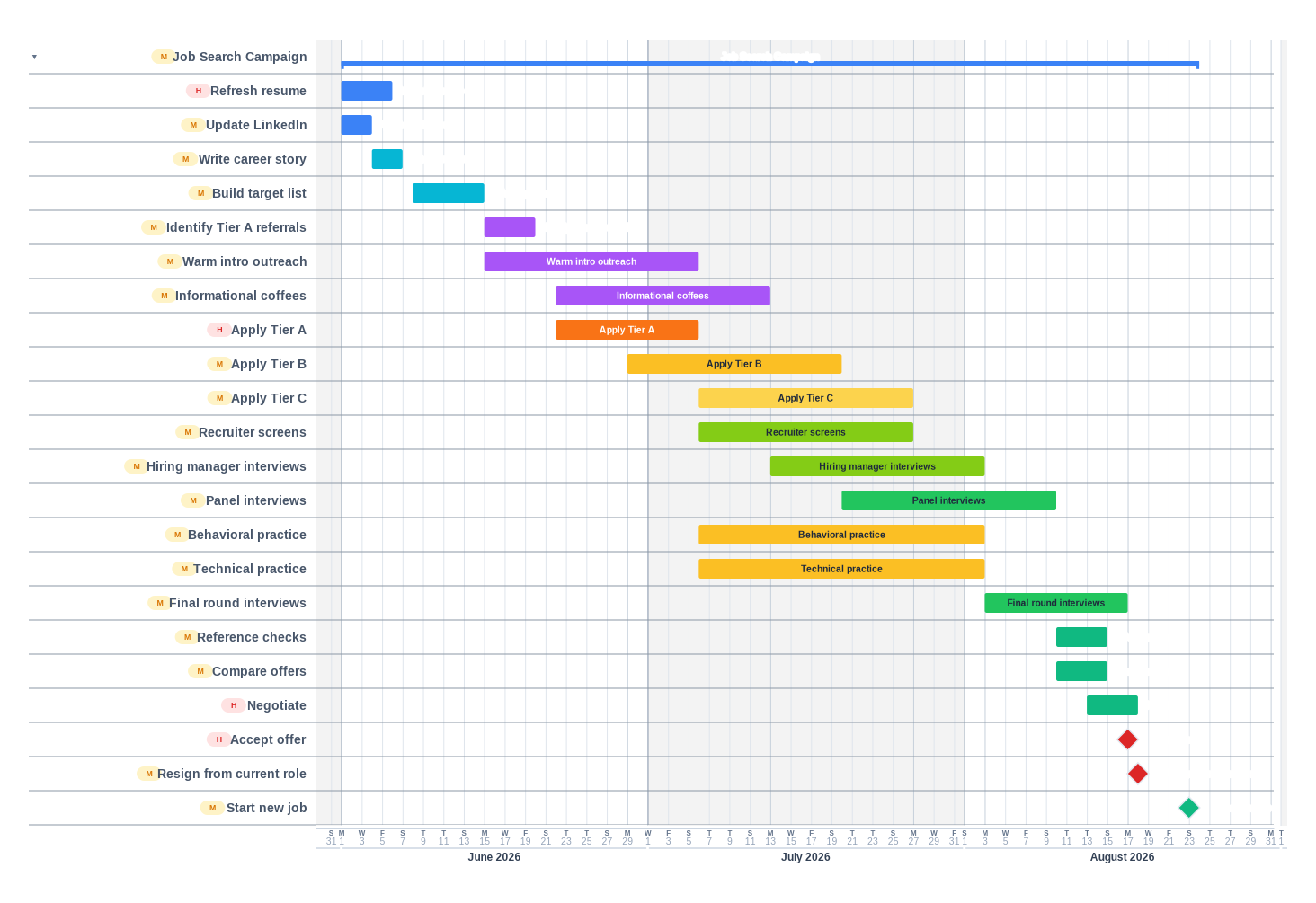
Job Search22 tasks · 5 phases · 12 weeks
Job Search Gantt chart: 22 tasks across 5 phases over 12 weeks
The template as it opens in the app. Its example dates start on 1 June 2026. Change them to fit your project.

About this template

A focused job search rarely happens in one week. Resume tuning takes longer than expected, target lists need a few rounds, and networking conversations compound over weeks. This 12-week template assumes a mid-career professional running a focused search: typically 4–6 target companies of primary interest plus a wider pool for breadth. Adjust the application volume to your seniority level.

How a 12-week job search breaks down

01

Set up

Weeks 1–2

Update resume and LinkedIn. Write a 1-paragraph "career story" you can deliver in any networking conversation. Build a target list of 30–50 companies, broken into Tier A (4–6 dream companies), Tier B (15–20 strong fits), and Tier C (the wider pool for breadth and momentum).

Steps in this phase
  • Refresh resume (1–2 pages, ATS-friendly)
  • Update LinkedIn headline, photo, About section
  • Write career story (1 paragraph)
  • Build target company list
  • Identify 5–10 key roles to apply for
02

Network and warm intro

Weeks 3–5

For each Tier A company, identify 2–3 internal contacts via LinkedIn. Reach out with a tailored note: referrals dramatically outperform cold applications. Have 5–10 informational coffee chats per week. Networking compounds: the 30th person knows what the first 5 did not.

Steps in this phase
  • Identify referrals at Tier A companies
  • Send 5–10 warm intro requests per week
  • Schedule informational coffees
  • Follow up within 48 hours of each conversation
03

Apply

Weeks 4–8

Apply to Tier A roles first, with a referral if possible. Then Tier B and Tier C in parallel. Customize the cover letter and resume bullets per role: generic applications waste both your time and the recruiter's. Aim for 5–10 carefully-customized applications per week, not 50 generic ones.

Steps in this phase
  • Apply to Tier A roles (with referral)
  • Apply to Tier B roles
  • Apply to Tier C roles
  • Track every application in a spreadsheet
  • Follow up at 7 and 14 days
04

Interview

Weeks 6–10

Recruiter screens → hiring manager → panel/team → final. Average loop is 4 weeks from first screen to offer. Prepare for behavioral and technical rounds separately: both require practice. Send a thank-you email within 24 hours of every interview.

Steps in this phase
  • Recruiter screens
  • Hiring manager interviews
  • Panel or team interviews
  • Final round interviews
  • Behavioral practice (STAR method)
  • Technical practice (role-specific)
  • Thank-you emails (within 24 hours)
05

Offer and negotiate

Weeks 11–12

Compare offers across base, bonus, equity, and benefits. Negotiate base and equity: almost every offer has room. Take 3–5 business days to decide; recruiters expect this. Once accepted, give notice to the current employer with a target start date 2–4 weeks out.

Steps in this phase
  • Compare offer packages
  • Negotiate base, bonus, equity
  • Reference checks
  • Accept offer
  • Resign from current role
  • Start new job

Tips from successful searches

  1. 01

    Get a referral for every Tier A application. Referrals lift response rate by 5–10x.

  2. 02

    Customize the cover letter and resume bullets per role. Five tailored applications beats fifty generic ones.

  3. 03

    Track every conversation in a spreadsheet: company, contact, status, date, next step. The mental load otherwise becomes the bottleneck.

  4. 04

    Negotiate every offer: almost every offer has room. Recruiters expect it.

  5. 05

    Schedule one rest day per week. Job search is grinding; burnout hurts both quality and your interview presence.

Questions

How long does a job search usually take?

Mid-career: 3–6 months. Senior: 4–8 months. Junior: 1–3 months. This template targets the 3-month case.

How many applications per week?

5–10 carefully-customized applications outperform 30–50 generic ones. Quality of fit and customization matter more than volume.

When should I negotiate?

After the verbal offer, before accepting. Almost every offer has 10–20% upside on base or equity.

Start with this template

Open the job search template, fit it to your search horizon, and you have a working 12-week plan with networking, applications, and interview rounds plotted.

Related templates

All 42 templates →