The critical path method (CPM) finds the earliest date on which a project can finish. That date follows from the length of the longest chain of dependent tasks from start to end. That chain is the critical path. It sets a hard floor on the schedule. No amount of work on tasks off that path moves the finish date by a single day.
The idea is simple, but it has an important consequence. In a plan with many task dependencies, most tasks have a little room to slip. A few do not. The critical path shows which is which. You can then give your attention to the tasks where a delay costs you the project.
Why the longest path is the shortest time
Take two chains of work that must both finish before you can ship. Chain A takes 12 days, and chain B takes 20 days. You can run them in parallel, but you cannot ship until both are done. The soonest you finish is 20 days, the length of the longer chain. A faster chain A changes nothing, because it already finishes with eight days to spare. This is the core of CPM. The longest path through the network is the shortest time that the whole project can take. Every other path has slack, which is spare time before it starts to delay the end.
A worked example
Take a small project with four tasks. The durations are in days, and all dependencies are finish-to-start. Start (S) and End (E) are zero-length markers.
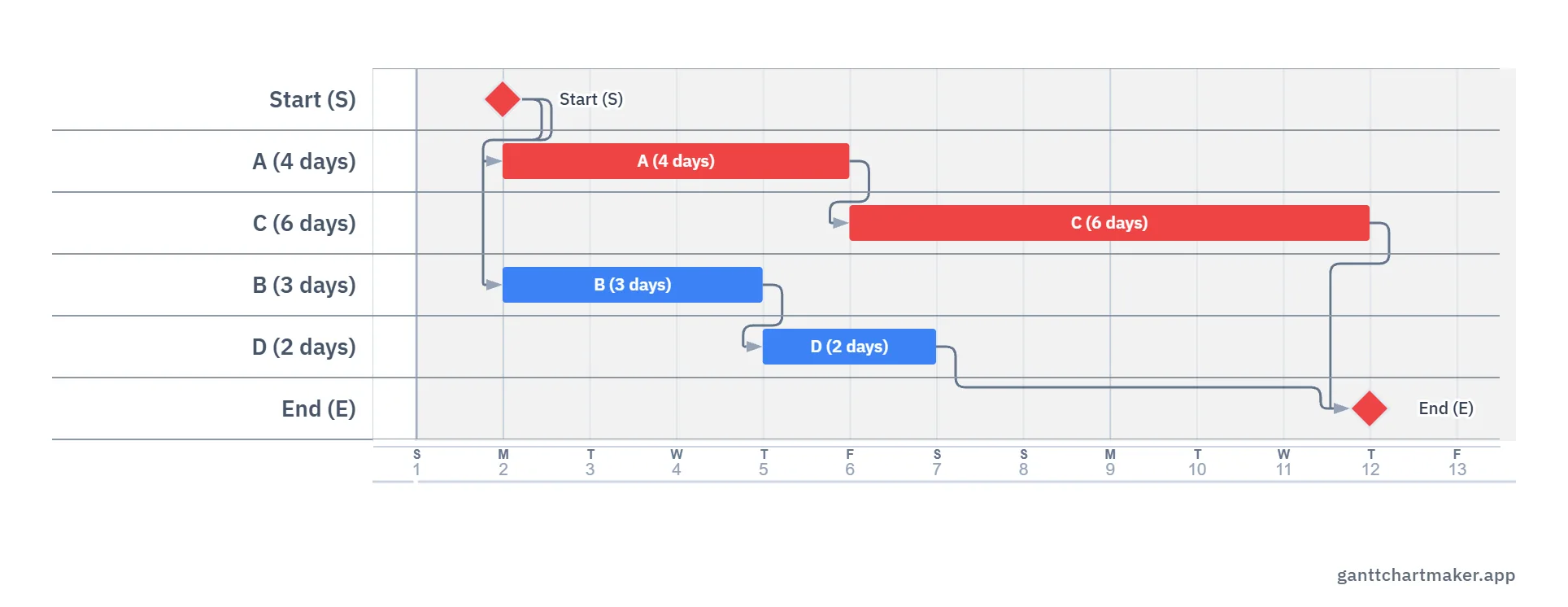
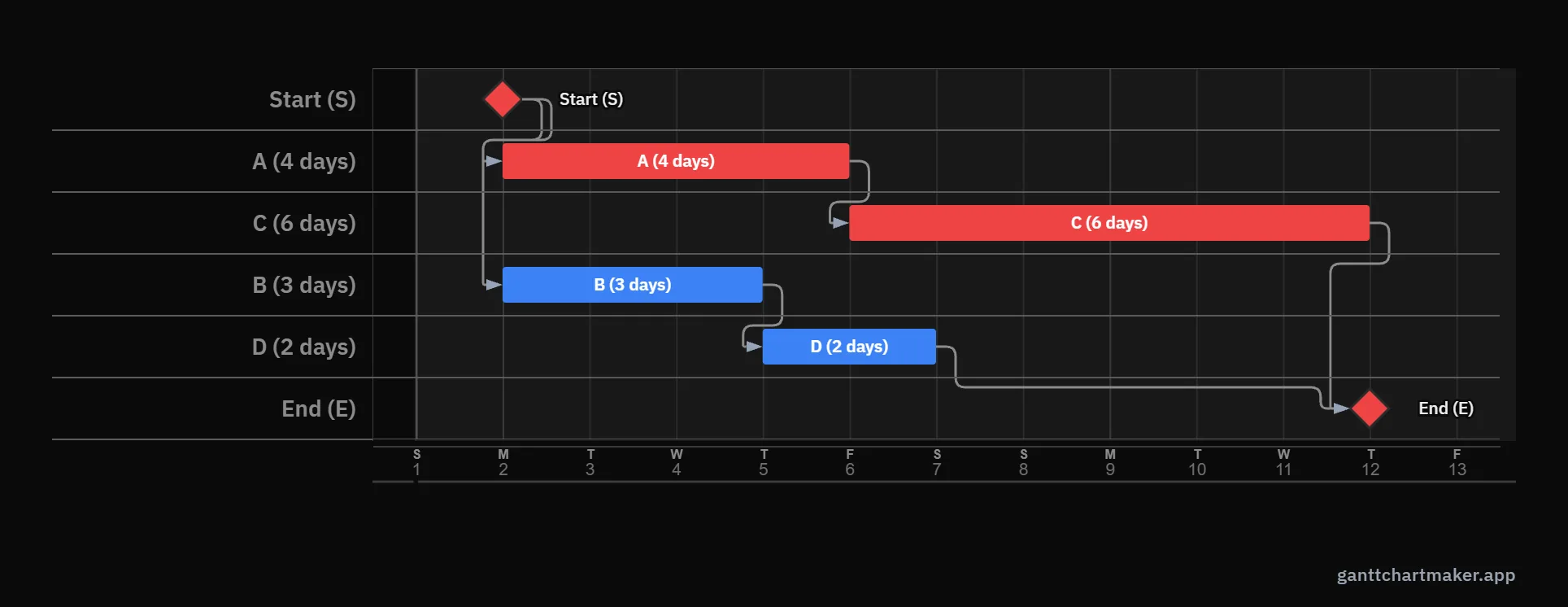
By eye the answer is clear. The top path totals 10 days and the bottom path only 5. But this does not work on real plans, so CPM gives you a procedure. It has two passes.
The forward pass: earliest dates
Work from left to right and calculate the early start (ES) and early finish (EF) of each task. The early start of a task is the latest early finish of all tasks that lead into it. Its early finish is its early start plus its duration. Count from day 0.
- A: ES 0, EF 4. B: ES 0, EF 3.
- C follows A: ES 4, EF 10. D follows B: ES 3, EF 5.
- E follows both C and D. Its early start is the later of the two finishes, which is 10 and not 5. So the project finishes on day 10.
At every merge point, you take the later finish. This is where the longest path wins.
The backward pass: latest dates
Now work from right to left from the finish. Calculate the late finish (LF) and late start (LS) of each task. These are the latest dates at which the task can happen without a delay to the end date. Start with E at 10 and subtract the durations.
- C: LF 10, LS 4. A: LF 4, LS 0.
- D: LF 10, LS 8. B: LF 8, LS 5.
The difference between the late date and the early date of a task is its float, or slack. Float is how long the task can slip before it delays the project. A and C have late dates equal to their early dates, so they have zero float. B has LS 5 against ES 0, which is five days of float. D has LS 8 against ES 3, which is also five days. B or D can start up to five days late, and the project still finishes on day 10.
Why critical tasks have zero float
A task is on the critical path because it has no float. Its earliest and latest dates are the same, so when it slips, the finish slips with it. Float and criticality are two views of one fact. The critical path is the chain of zero-float tasks that runs unbroken from start to finish. Slack and float explained covers total float, free float and negative float.
Do a forward pass for the earliest dates and a backward pass for the latest dates. A task where the two match is on the critical path. Float is the gap between them.
By hand versus by tool
Scheduling software uses the same two-pass method. It does the work at once and repeats it each time you change something. You drag a bar, add a dependency or lengthen a task. The tool then recalculates the whole network and marks the critical chain again. A hand calculation on a small plan is useful once. It teaches you what the software shows. After that, let the software do the arithmetic. A plan with fifty tasks has too many paths to trace reliably with a pencil. Your contribution is to choose the durations and dependencies with care. The passes are mechanical.
How to use the critical path
The critical path changes what you do day to day.
- Focus your attention on critical tasks. A one-day slip on a critical task moves the finish date by a day. The same slip on a task with five days of float costs nothing. Protect the critical tasks. Follow the tasks with float only when their float runs thin.
- Shorten the critical path on purpose. To finish sooner, you must shorten the critical path, and only the critical path. There are two methods. Crashing adds resources to a critical task, such as people, overtime or money, to make it shorter. Fast-tracking overlaps tasks that you planned in sequence. It usually turns a strict link into a link with lead time, so the successor starts before the predecessor finishes.
- Check again after every cut. If you crash or fast-track the critical path enough, a different path becomes the longest. The critical path moves. Work on the old one past that point wastes effort.
Caveats
CPM is a powerful model, and every model simplifies.
- The critical path shifts as the plan changes. It is correct for the durations that you entered today. If you re-estimate a task, add a dependency or move a date, it can jump to a different chain. Treat it as a live readout and not a fixed fact. Keep your duration estimates accurate, because the whole result depends on them.
- Near-critical paths matter. A path with one or two days of float is not safe. One small slip makes it critical. Watch the runners-up as well as the leader.
- The longest single task is not necessarily on the critical path. An eight-day task on a nine-day path is less dangerous than a three-day task on the ten-day critical path. Criticality depends on the path, and not on the size of one bar. Many people get this wrong, and it is costly.
- CPM assumes that durations are fixed and resources are unlimited. Classic CPM ignores that two "parallel" tasks can need the same person at once. Resource levelling and critical chain address this problem. For that reason, the textbook critical path is a first step and does not answer every question.
Questions
What is the difference between the critical path and the longest task?
They are different things. The critical path is the longest chain of dependent tasks from start to finish. The longest single task can sit on a short path with plenty of float. A small task on the critical path drives the end date. A large task off it does not.
Can a project have more than one critical path?
Yes. If two or more paths share the same longest length, every task on each path has zero float. All of those paths are critical. That makes the schedule more fragile, because a slip on any of them moves the finish.
Does the critical path change during a project?
Often. Tasks finish early or late, and estimates change, so the longest path can shift to a different chain. Good tools recompute it continuously. Read it as a live indicator and not as a one-time calculation.
What is the difference between crashing and fast-tracking?
Crashing adds resources, such as people, overtime or money, to shorten a critical task. It tends to raise cost. Fast-tracking overlaps tasks that you planned in sequence. It adds risk and rework instead of cost. Both help only when you apply them to the critical path.