Gantt Chart Maker Open App

Film production Gantt chart template

A 6-month short film or feature production plan covering development, pre-production, production, post, sound, color, music and distribution, with the rolling departments that decide whether a film stays on schedule.

Duration
6 months
Phases
6
Tasks
29
Format
.gantt
Film Production29 tasks · 6 phases · 6 months
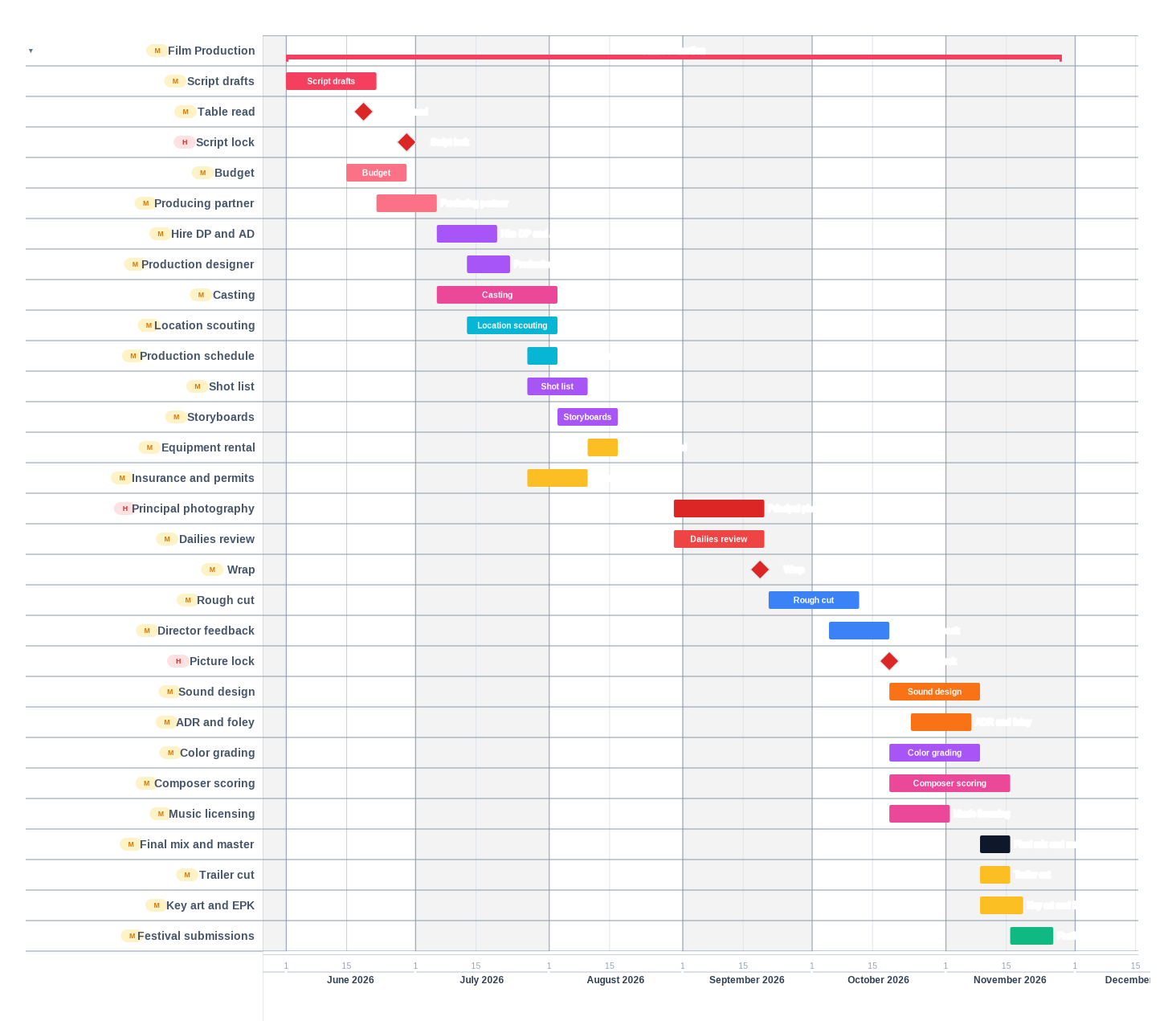
Film Production Gantt chart: 29 tasks across 6 phases over 6 months
The template as it opens in the app. Its example dates start on 1 June 2026. Change them to fit your project.

About this template

Film production is one of the most logistically dense projects in the creative world. Pre-production sets up everything (location, crew, cast, equipment, schedule) so that the shoot, which costs the most per day, runs without surprises. This 6-month template covers a short film or low-budget feature. The pre-pro and post-pro phases are intentionally long because compressed schedules in either reliably hurt the final film.

How a 6-month film project breaks down

01

Development

Month 1

Script lock: multiple drafts, table reads, feedback. Budget. Producing partner or production company attached. Pitch deck if seeking financing. Most projects spend more time in development than any other phase; that is fine, because the script and budget are the foundation everything sits on.

Steps in this phase
  • Script drafts (3–5 passes)
  • Table read
  • Lock script
  • Budget
  • Producing partner
  • Pitch deck (if seeking financing)
02

Pre-production

Months 2–3

Crew hiring, casting, location scouting, schedule, shot list, storyboards, equipment rental, insurance. Pre-production failures cause production day overruns. Spend the time here so the shoot is execution, not problem-solving.

Steps in this phase
  • Hire key crew (DP, AD, production designer)
  • Casting
  • Location scouting
  • Production schedule (shoot order)
  • Shot list and storyboards
  • Equipment rental
  • Insurance and permits
  • Catering and craft services
03

Production

Month 4

The shoot: typically 2–6 weeks for short films, 4–8 weeks for low-budget features. 10–12 hour days are common but unsustainable past 5 days/week. Daily call sheets distributed by 6pm the day before. Dailies reviewed each evening. Coverage notes: every scene shot from enough angles to give the editor real options.

Steps in this phase
  • Daily call sheets
  • Principal photography
  • Dailies review (each evening)
  • Coverage notes
  • Wrap each location with checklist
04

Post: picture

Month 5

Editor assembles a rough cut. Director and producer feedback rounds. Picture lock: the final cut where no more scene changes happen. After picture lock, sound design and color grading begin in earnest. Locking picture is the most-missed milestone in indie film, because every additional change cascades into sound and color.

Steps in this phase
  • Rough cut
  • Director feedback
  • Producer feedback
  • Picture lock
  • VFX work if applicable
05

Post: sound, color, music

Month 5–6

Sound design, ADR (additional dialogue recording), foley, mix. Color grading. Composer scores to picture-lock. Music supervision for any licensed tracks. Final mix and master. These three departments work in parallel after picture lock.

Steps in this phase
  • Sound design
  • ADR sessions
  • Foley
  • Sound mix
  • Color grading
  • Composer scoring
  • Music licensing
  • Final mix and master
06

Distribution

Month 6

Deliverables: master files in multiple formats, closed captions, trailer cut, key art, EPK. Festival submissions if going that route. Most festivals require 6+ months lead time. Distribution strategy: festivals first, then streaming, or direct to streaming/VOD.

Steps in this phase
  • Master deliverables (multiple formats)
  • Closed captions
  • Trailer cut
  • Key art and EPK
  • Festival submissions
  • Distribution strategy

Tips from finished films

  1. 01

    Lock the script before pre-production. Changes after pre-pro lock cost real money.

  2. 02

    Spend more time in pre-production than feels comfortable. The shoot is execution, not problem-solving.

  3. 03

    Daily call sheets out by 6pm the day before. Late call sheets ripple into every department.

  4. 04

    Lock picture before sound, color, or music start in earnest. Every late picture change cascades.

  5. 05

    Submit to festivals 6+ months before the date. Late submissions are the most common reason indie films miss their target festival.

Questions

How long does a film take to make?

Short film: 3–6 months. Low-budget feature: 9–18 months. Studio feature: 2–4 years. This template targets the short film / low-budget feature case.

What is the most common cause of overruns?

Insufficient pre-production. Compressed pre-pro reliably produces a chaotic shoot, which produces a worse film for the same budget.

Should I submit to festivals or go direct to streaming?

Depends on the film. Genre films and shorts often do better with the festival route; documentaries often benefit from a streaming-first strategy. Decide before locking picture.

Start with this template

Open the film template, fit it to your shoot dates, and you have a working 6-month plan with pre-pro, shoot, and post laid out.

Related templates

All 42 templates →