Gantt Chart Maker Open App

Conference planning Gantt chart template

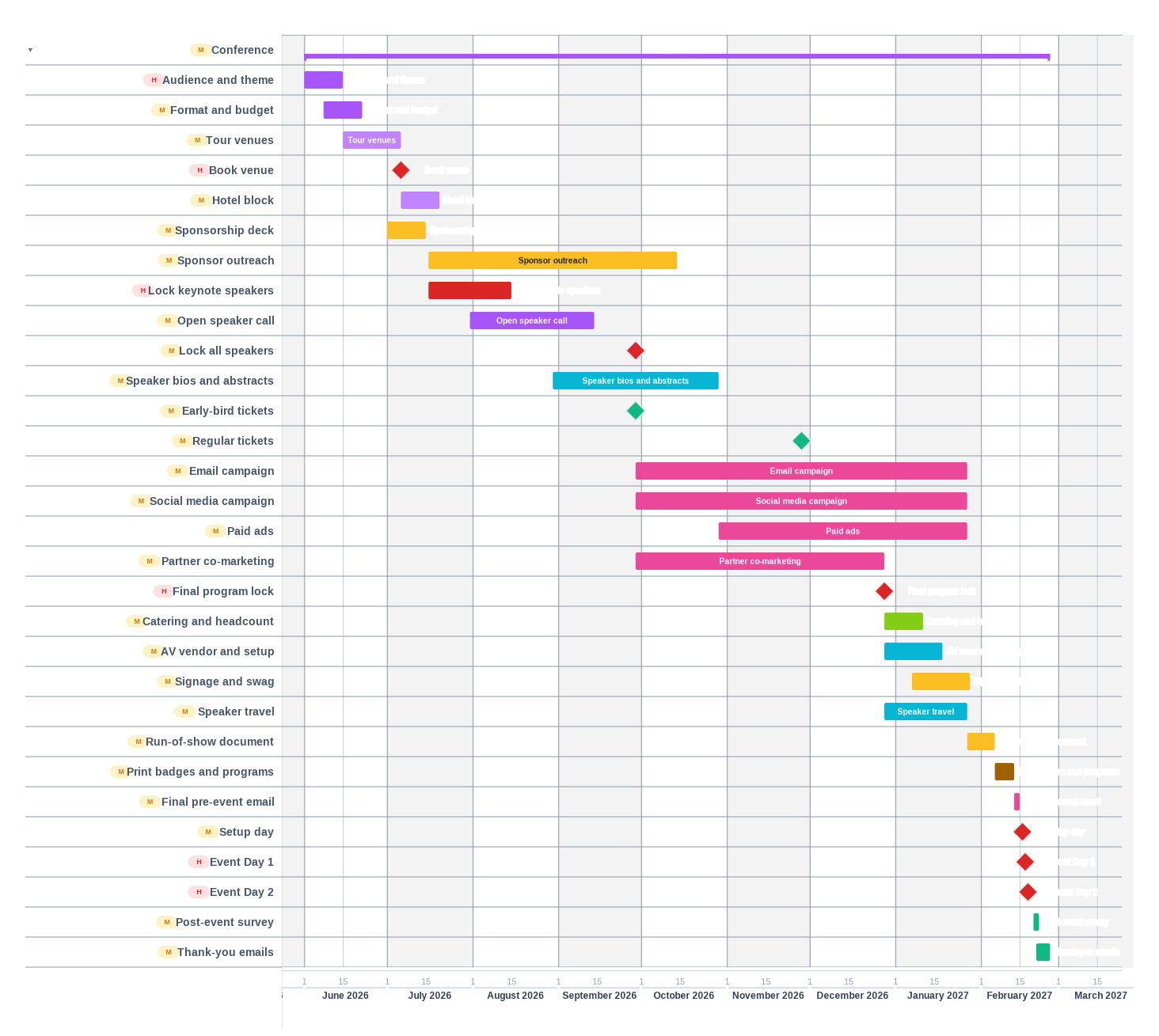
A 9-month conference plan covering venue, sponsors, speakers, ticketing, marketing, AV, run-of-show and post-event, for organizers running an in-person event of 100 to 1,000 attendees.

Duration
9 months
Phases
6
Tasks
30
Format
.gantt
Conference Planning30 tasks · 6 phases · 9 months
Conference Planning Gantt chart: 30 tasks across 6 phases over 9 months
The template as it opens in the app. Its example dates start on 1 June 2026. Change them to fit your project.

About this template

Conferences are 200+ interlocking deadlines pretending to be one event. Venue contracts have refund cliffs at 60/30/14 days out. Speakers cancel. Sponsors require lead time for booth materials. Hotel blocks fill or release. This 9-month template plans a typical mid-size conference of 100–1,000 attendees, with the long-lead items (venue, sponsors, speakers) at month 1 and the marketing/operations push tightening into the final 8 weeks.

How a 9-month conference plan breaks down

01

Strategy and venue

Months 1–2

Define audience, theme, format (single-track vs. multi-track), expected attendance. Build the budget. Tour and book the venue 6–9 months out for popular venues. Hotel block negotiated at the same time. Lock the date.

Steps in this phase
  • Define audience and theme
  • Format decision
  • Budget
  • Tour and book venue
  • Hotel block
  • Date locked
02

Sponsors and speakers

Months 2–5

Sponsorship deck (tiers, deliverables, prices). Sponsor outreach. Keynote speakers locked first. They anchor the program. Open call for speakers or curated invites. Speaker management: bios, headshots, talk abstracts, AV requirements.

Steps in this phase
  • Sponsorship deck
  • Sponsor outreach
  • Lock keynote speakers
  • Open speaker call (or curated invites)
  • Speaker bios, headshots, abstracts
  • Speaker AV requirements
03

Ticketing and marketing

Months 4–8

Early-bird tickets at month 4. Regular tickets at month 6. Marketing campaign: email, social, paid, partnerships. Track sales weekly. If sales lag, additional partner outreach or content marketing in months 5–7. Final-week ticket push usually accounts for 20–30% of total sales.

Steps in this phase
  • Early-bird tickets live
  • Regular tickets live
  • Email campaign
  • Social media campaign
  • Paid ads (if budget)
  • Partner co-marketing
  • Weekly sales tracking
  • Final push (last 2 weeks)
04

Logistics and program

Months 6–8

Final program (sessions, rooms, times). Catering menu and headcount. AV vendor and setup. Signage. Swag and badges. Speaker travel and accommodation. Run-of-show document: minute-by-minute schedule for staff.

Steps in this phase
  • Final program lock
  • Catering and headcount
  • AV vendor and setup
  • Signage
  • Swag and badges
  • Speaker travel
  • Run-of-show document
  • Staff briefing
05

Final 2 weeks

Months 8–9

Final attendee count to venue and caterer. Print badges and programs. Send pre-event email to attendees with logistics. Build event app (or use an existing platform). Walk through the venue 1–2 days before. Setup day.

Steps in this phase
  • Final attendee count
  • Print badges and programs
  • Pre-event email to attendees
  • Event app or platform
  • Venue walkthrough
  • Setup day
06

Event and follow-up

Month 9

Event days: staff at every entrance, AV crew on every track, registration open through end of day 1. Capture photos and video. Post-event survey within 48 hours. Thank-you emails to attendees, sponsors, and speakers within 1 week. Post-event report and lessons learned.

Steps in this phase
  • Event Day 1
  • Event Day 2
  • Tear down
  • Post-event survey (within 48h)
  • Thank-you emails
  • Photo and video delivery
  • Sponsor follow-up
  • Lessons learned report

Tips from conferences that came in under chaos

  1. 01

    Book the venue 6–9 months out. Popular venues and good dates fill 9–12 months ahead.

  2. 02

    Lock keynote speakers first. They anchor the program and unlock everything downstream.

  3. 03

    Early-bird at 4 months out. Early tickets fund the venue deposit and gauge demand.

  4. 04

    Build the run-of-show document. Minute-by-minute schedules make event-day chaos manageable.

  5. 05

    Send the post-event survey within 48 hours. Memory fades fast; response rate drops 10–20% per week of delay.

Questions

How long do I need to plan a conference?

6–12 months for mid-size conferences (100–1,000 attendees). Larger conferences (5,000+) often plan 18+ months out.

What is the single biggest budget category?

Venue + F&B usually 40–60% of budget. AV is 10–20%. Speakers are 5–15% depending on whether you pay or comp.

When should I start selling tickets?

4–5 months out for early-bird. Earlier than that and people forget; later and you miss the early-buyer segment.

Start with this template

Open the conference template, fit it to your event date, and you have a working 9-month plan with the 200 interlocking deadlines plotted.

Related templates

All 42 templates →